Home Author
Author

Emily Patterson

Advertisement

For many Australian households, the cost of living is measured less by national statistics than by what remains in a bank account after rent, groceries, petrol and bills are paid. Pressure persists despite tax relief and support measures. With inflation still above the Reserve Bank’s target range, politicians face difficult choices about how to assist families without adding to broader price pressures.

The Australian Bureau of Statistics reported annual consumer price inflation of 4.0 per cent in August 2026, up from 3.5 per cent in July. That does not mean every product became 4 per cent more expensive or that prices increased by that amount in a single month. The Consumer Price Index tracks a basket of household purchases, and its changes vary considerably between housing, food, transport and other categories. People experience those changes differently according to where they live and what they spend.

Interest rates remain central to the discussion. On 29 September 2026, the Reserve Bank of Australia lifted its cash rate target by 0.25 percentage points to 4.60 per cent, citing elevated inflation and renewed risks, including higher global energy costs. Higher rates are intended to restrain borrowing and spending, helping bring inflation down over time. They can also increase mortgage repayments and business financing costs, creating hardship for borrowers before prices stabilise.

The federal government has chosen tax cuts as one way to improve take-home pay. From 1 July 2026, the income-tax rate on the relevant portion of taxable earnings between $18,201 and $45,000 fell from 16 to 15 per cent. It is scheduled to fall to 14 per cent from July 2027. These changes can leave eligible taxpayers with more money, although the size of the benefit depends on income and personal circumstances. A tax cut does not directly reduce the sticker price of groceries or electricity.


Pages: 1 2

Advertisement

Australia’s electricity system is undergoing a major transformation. Rooftop solar panels, large wind farms and batteries are becoming more important as ageing coal-fired power stations move towards retirement. The shift is often described as a debate about climate policy, but it is equally a question of whether households and businesses can rely on affordable electricity at every hour of the day.

The federal government has set an ambition for renewable sources to supply 82 per cent of electricity by 2030. Reaching that figure requires more than constructing solar and wind projects. Electricity must also reach the places where people use it, and the system needs enough flexible capacity when sunlight and wind output are low. These are the practical challenges now shaping energy policy across the country.

In June 2026, the Australian Energy Market Operator published its latest Integrated System Plan for the National Electricity Market. It found that renewables connected through upgraded transmission and distribution networks, supported by storage and backed by gas, represent the least-cost development path through to 2050 under the plan’s assumptions and policy settings. This is a planning assessment rather than a guarantee that every proposed project will be delivered on time or that bills will immediately fall.

Solar power is especially visible in Australia because so many households have panels on their roofs. During sunny periods, these systems can reduce demand for electricity supplied from large power stations. But their contribution changes throughout the day, and evening demand often arrives after solar generation drops. Batteries can store some surplus electricity and release it later, while other flexible resources help keep supply and demand balanced.

Wind generation adds a different production pattern and can contribute when solar output is weak. Its value also depends on location, weather and access to the grid. New transmission lines could connect renewable resources in regional areas with cities and industrial customers. Supporters regard these connections as essential for replacing retiring coal capacity. Critics point to their cost, lengthy approvals and potential impacts on farms, landscapes and local communities.

Pages: 1 2

Advertisement

Migration has become one of Australia’s most contested policy questions, touching housing, employment, universities, family life and economic growth. The debate is often framed as a choice between welcoming newcomers and controlling population pressures. In practice, it involves several different systems, and treating them as one can make proposed reforms sound simpler than they really are.

A key distinction is between permanent migration places and net overseas migration. The first is a government planning programme covering many skilled and family visas. The second is a population measure of people arriving and departing for long enough to be counted as migrants, including temporary visa holders. Changing the permanent programme does not translate directly into an equal change in net migration, because students, working holiday makers and returning residents also influence the figures.

The federal government has set the 2026–27 permanent migration programme at 185,000 places, the same overall level as the previous year. Of these, 132,240 are allocated to skilled migration and 52,500 to family migration, with a further 300 places for special eligibility. The emphasis on skilled places reflects the importance of filling workforce gaps while allowing Australians to reunite with partners, children and other eligible relatives.

Recent population figures provide context. The Australian Bureau of Statistics estimated net overseas migration of about 292,100 people in the year ending March 2026, down from the previous year. It also recorded 557,500 migrant arrivals and 265,400 departures during that period. These are preliminary population estimates, not counts of permanent visas granted. They show why political claims about a single migration number need to be examined carefully.

Pages: 1 2

Advertisement

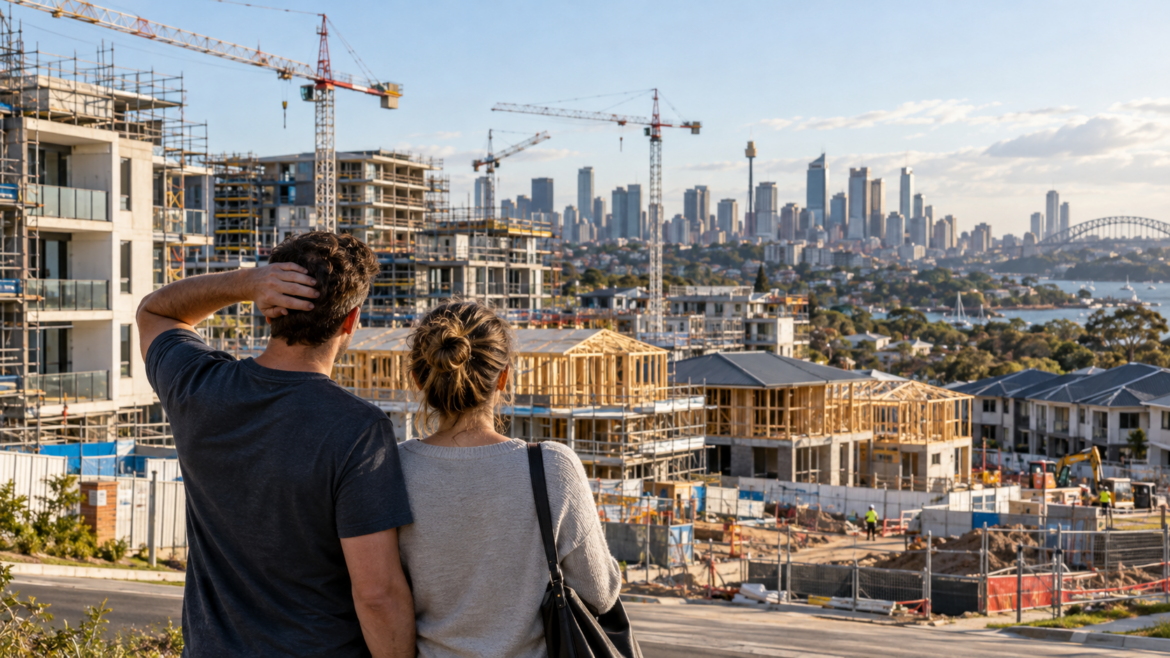
Australia has set itself an ambitious housing goal: 1.2 million new homes over the five years from July 2024 to June 2029. The target, agreed under the National Housing Accord, is intended to ease a shortage that has pushed rents and purchase prices beyond the reach of many households. Two years into the programme, the question is less about the size of the promise than whether the building industry can deliver homes quickly enough.

Meeting the target would require an average of 240,000 new homes a year. Yet the latest figures show why that rate is difficult to sustain. Australian Bureau of Statistics data released in October 2026 recorded 47,168 dwelling completions in the June quarter on a seasonally adjusted basis, up 5.8 per cent from the preceding quarter. Work started on 52,201 homes, a quarterly rise of 7 per cent. Both numbers suggest activity is improving, but neither is close to the pace required if repeated across a full year.

The National Housing Supply and Affordability Council has also warned about the distance between ambition and likely delivery. In its April 2026 report, the council projected about 980,000 gross new dwellings during the Accord period under its early-2026 outlook. That would leave a shortfall of roughly 220,000 compared with the national goal. The projection is not a final result: construction conditions, policy decisions and future demand can change it substantially.

Why does Australia struggle to build faster? A home cannot appear simply because a planning target has been announced. Builders need land with suitable zoning, roads, water connections, financing, materials and a skilled workforce. Delays in one area can prevent progress in another. Higher borrowing costs make projects harder to finance, while shortages of tradespeople can extend construction schedules or increase prices for buyers and developers.

The picture also varies by location. Sydney and Melbourne face different pressures from growing suburbs in Brisbane, Perth or regional centres. An apartment project near a railway station can house many people on a relatively small site, but it may require complex approvals and expensive infrastructure. Detached housing on urban fringes can be quicker to plan in some places, yet residents still need transport, schools, healthcare and employment nearby. Counting dwellings without considering their location risks producing the wrong homes in the wrong places.

Pages: 1 2

Advertisement

Australia’s approach to children’s online lives has entered a new phase. Since 10 December 2025, social media services covered by the country’s minimum-age rules have been required to take reasonable steps to stop Australians younger than 16 from holding accounts. The policy is one of the most closely watched experiments in online safety, but its practical meaning is more specific than the phrase “social media ban” suggests.

The obligation falls on platforms, not children or parents. Families are not fined because a teenager opens an account, and the law does not prohibit every visit to a social website. Public material that can be viewed without signing in may remain accessible. The central change is that selected services cannot knowingly allow under-16s to maintain ordinary accounts, even with parental permission.

Australia’s eSafety Commissioner identifies Facebook, Instagram, Snapchat, Threads, TikTok, Twitch, X, YouTube, Kick and Reddit as age-restricted services. The list can be reviewed as platforms evolve. Messaging, educational and gaming services are not automatically treated in the same way. Among the services eSafety has identified as outside the current restrictions are WhatsApp, Messenger, Google Classroom, Roblox and YouTube Kids. That distinction matters for teenagers who depend on online tools for schoolwork, friendships and hobbies.

For parents, the first visible difference may be an account notice, an age check or the loss of access to an existing profile. Platforms decide how to establish that an account holder meets the age requirement, within legal and privacy constraints. An age check does not necessarily mean uploading a passport or driver’s licence. The challenge is to prevent access by younger users without collecting excessive personal information or mistakenly locking out people who are old enough.

The government argues that delaying access can reduce exposure to design features that encourage prolonged scrolling and constant checking. Notifications, personalised recommendations and public popularity metrics can make it difficult for teenagers to switch off. Supporters say a common minimum age also gives parents a clearer starting point for conversations about online pressure, rather than leaving every family to negotiate different rules in isolation.

Pages: 1 2

Advertisement

Older Posts

About us

logo

Disclaimer

Southern Meridian provides news, analysis and general information for informational purposes only. While we strive for accuracy, information may change over time. Content related to health, finance or legal matters should not be considered professional advice. Views expressed in articles do not necessarily reflect those of the editorial team.